
Tag mobile

For a hacker, the Pre is incredible

Great stuff. Perhaps I should start looking at the Pre as one of the candidate platforms for the Geo|Ads platform and the apps it is currently featured on. Since AthensBook 1.0.0 came out in early March we've been focusing on way too many things and looking at what Palm has to one of them --- besides registering for the early SDK access back in April, there were few reasons to focus on the Pre: it is only available stateside for now, and we're already focusing on providing current releases of our apps and ad SDK on iPhone/Android and Blackberry. Still, with Android still featuring a decade-old UI and no devices not being available in Hellas in any sort of mainstream way yet [soon that's bound to change of course] and with the BlackBerry OS seeming increasingly dated, perhaps the Pre should be getting some more developer love from us. If only we could get a device in this part of the world. =)
Nokia is The Past. Welcome to the Future.

I have written about Nokia and the need for the company to reinvent itself several times in the past. When the iPhone was announced in early 2007, I was lukewarm and slightly frustrated that the Mac, Apple’s former, at times sole and by far most important strategic product was complemented by a formidable ‘opponent’. I […]

Developer G1 Phone

This, unlocked, sim-free phone sells for $399.
Participating markets include US, UK, Germany, Japan, India, Canada, France, Taiwan, Spain, Australia, Singapore, Switzerland, Netherlands, Austria, Sweden, Finland, Poland, and Hungary.
Naturally, Hellas could not have been a 'participating market', simply because there are no developers here. Sigh. [Relevant Google page]

An Empty Promise?

Ars Technica writes of the recent controversy on Google's commitment to an open source Android, the transparency of the development process and the availability of the SDK. Valid criticism for the most part, but no conclusive proof of Google's bad intentions. Yet, it'd really be a shame if Google, a company that hasn't really faltered until now, misses its chance in the mobile phone industry through the alienation of the community and the betrayal of its own values.

Marginally better than expected.

But certainly worse than what I hoped for. The iPhone 3G is a marginally improved device that builds upon the very solid foundations of the first iPhone by adding 3G connectivity (though without the video conferencing part) and version 2.0 of the software and does this at a significantly reduced price --- which is probably the highlight of the keynote. It's also available in many more countries, including Hellas. While I may get my hands on one pretty soon, I still think that the Nokia N95 is a superior device in many ways, and one that's mostly hurt by the vastly inferior (from a usability point of view) application software stack. The new iPhone seems like a buffer solution to the consumerism that brands the original as 'old' and whose price and attractive featureset, augmented by a software ecosystem, wider availability and faster network performance are certainly going to serve as catalysts while it becomes a(n even more) mainstream product and expand Apple's market share in this difficult market. That is, until a much evolved model appears in 12-18 months from today. Update: I've already read several comments about the contract prices in various countries; it'll be interesting to see how this plays out in Europe and especially in Hellas, a country where mobile internet access costs about 70% more than the US. If 3G access is forced onto consumers buying the iPhone (which it will), the adjusted $199-$299 price points won't make a difference to people --- especially if the contract means a monthly cost higher than €30. Update 2: It is now blatantly clear that the price reduction, even in the US, is marginal at best; the new contract coupled with higher prices for data connectivity make the new iPhone cheap to buy, but expensive to maintain.

WidSets. What a disappointment.

A reader of this blog sent me an email a couple of weeks ago, asking me to consider porting my Hellenic Reverse Directory Lookup widget (HRDL) for Apple’s Dashboard in Mac OS X to the Widsets service provided by Nokia. Over the past year or so I’ve been emailed another two or three times by […]

Nokia Maps 2.0β

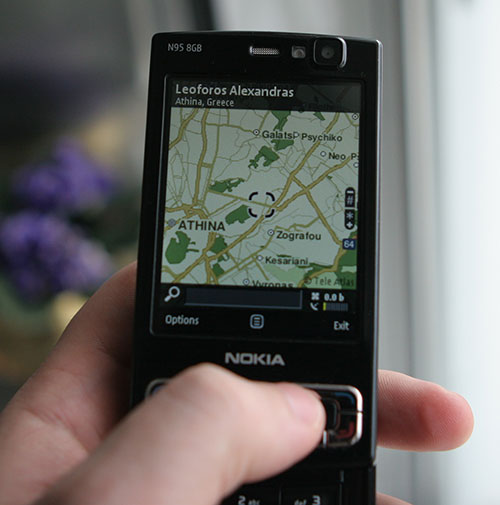
Nokia has been after the navigation market for quite a while now. The free inclusion of Nokia Maps in some of its high end models and the fact that the application and maps are given for free --- with the user optionally purchasing navigation for set amounts of time and having access to updated maps whenever those are available --- was in itself a radical departure from the buy-to-own products sold by companies like Tomtom, Navigon, Destinator, Michelin etc. Nokia's €5.7bn acquisition of Navteq, one of the two major mapping companies around, cemented what was previously speculation about Nokia's interest in this market. While accessible and relatively economical, Nokia Maps 1.0 was not without its problems: a relatively disingenious interface coupled with slow performance left it trailing far behind its leading rivals. Today Nokia released Nokia Maps 2.0 in beta form, for free on their Nokia Betalabs web site. The new application sports a much improved user interface, faster performance, new map modes (satellite and hybrid modes were added) and a clear shift towards catering equally for pedestrians as well as drivers --- a very welcome addition, sorely missing for the most part from other offerings.
Nokia Maps 2.0 on the N95 8GB
To my eyes, Nokia has already surpassed many of its competitors in the market in navigation and mapping. Its inclusion of free mapping and (paid) navigation functionality in mobile phones leverages its dominant position in the mobile phone industry and might render it a trojan horse, its more 'traditional' competitors might not be able to counter. We live, after all, in the era of convergence.

French law required Orange to offer an unlocked version [of the iPhone]

Not exactly news, but it merits some comments. It's interesting how proper regulation can help turn corporate strategy into consumer power. Surprisingly, even with purely free-market criteria, in 'over-regulated' France, Apple's toyphone is better value, more competitive and a better product offering as it costs €749 if bought unlocked, and €399 if bought locked to Orange --- although according to French Law, the carrier will have to unlock it, on request, after 6 months for free. Similarly, for the brief period of time it was sold unlocked in Germany, it cost €999. Naturally, in the US, there is no regulation and Apple can go ahead and set the terms of sale without any restrictions: that's probably why there is no unlocked iPhone on sale at all.

Nokia's Future.

I just read this article on The Register about Nokia’s view of the future of mobile phones, Web 2.0, mobile internet etc. I generally like Nokia, they’ve managed to overcome their long-established image as a relatively small, insignificant player from Finland and turned themselves into the goliath of mobile phones in less than a decade. […]

FakeStevey got it…wrong.

Check this post by Fake Steve Jobs. It's hilarious and not just because it nails what the real Steve Jobs probably thinks of Openness, but also because it highlights what was always wrong with his approach: whenever his companies were weak (NeXT in the late 80s and early 90s, Apple in the late 90s and early 2000s) he touted Openness, standards and formed alliances with other companies. Take Adobe's Display PostScript in NeXTSTEP, Darwin, Display PDF, OpenGL, OpenAL, CUPS, UNIX certification, gcc and a number of other standards, APIs, libraries and applications between 2001 and today in OS X or his 'agreement' with Microsoft in 1997. But just when things do well, he tries to usurp the dominant position, showing complete disregard to their partners, development community, users and sometimes even employees. In my discussions about Android with friends over the past day I compared Google with Microsoft in the 80s. Many have done the same. This comment by 'chickenface' in the linked article is, I believe, representative of how I see Android evolving and eventually dominating the market:
This is 1984, the iphone is the 128K Mac, and GPhone is the PC. Look, there's no actual consortium; there's Google and its customers. Kinda like Apple and AT&T, but they've got so many customers we're calling it a consortium. When're you gonna get this straight: Microsoft were like the Klingons - we made a sort of peace with them and held our nose. Google, they're way worse -- they're the Borg.