» Heavy-handed tactics and Misdeeds

It seems that OOXML, the Microsoft patent-riddled trojan horse and miserable excuse of a standard (let alone an open one) has been approved by ISO, following Norway’s and Britain’s mysterious (and very suspicious) change of heart. At the same time, ‘a number of delegates from the 87 national standards groups have been loudly complaining about alleged heavy-handed tactics and misdeeds in the voting process’. Even if Microsoft products didn’t suck, that would be reason enough to actively embargo them.

comments


2008.03.31

Πολιτιστική Κληρονομιά, ‘Πειρατεία’ και ΟΠΙ

‘Άκουσα’ από το blog του Ματθαίου Τσιμιτάκη την (ηχητική) συνέντευξη της διευθύντριας του Οργανισμού Πνευματικής Ιδιοκτησίας, κα. Ειρήνη Σταματούδη, τόσο σχετικά με το ζήτημα της πειρατείας όσο και σχετικά με το ζήτημα της πολιτιστικής κληρονομιάς και της διαφύλαξης των πνευματικών δικαιωμάτων.

Υπάρχουν διάφορα σημεία που θεωρώ ιδιαίτερα σημαντικά και άξια συζητήσης και τα οποία, αν μη τι άλλο, φέρνουν στην επιφάνεια το τεράστιο χάσμα που υπάρχει στις ημέρες μας μεταξύ της μεγάλης πλειοψηφίας του κόσμου και των ελάχιστων mainstream παραγωγών πολυμέσων1

Ο ορισμός της πειρατείας

Η βιομηχανία παραγωγής μουσικής και κινηματογράφου (πολυμέσων) από τις αρχές του 20ου αιώνα έχει προσπαθήσει, με τον ένα τρόπο ή τον άλλο, να μεγιστοποιήσει τα κέρδη της από τη πώληση των έργων αυτών, είτε ελέγχωντας τη παραγωγή τους από τους δημιουργούς (εξέχοντα παραδείγματα αποτελούν ο τρόπος με τον οποίο αντιμετωπίστηκαν καλλιτέχνες όπως ο Prince και οι TLC τη περασμένη δεκαετία), είτε τη πώληση και την αναπαραγωγή τους από το κοινό. Σε ό,τι αφορά το τελευταίο, παραδείγματα αποτελούν η στάση της βιομηχανίας απέναντι σε μαγνητικά μέσα εγγραφής, όπως η κασέτα και το 8-track τη δεκαετία του 1960 και οι εγγραφείς VHS τη δεκαετία του 1980 αλλά και άλλα μέσα διανομής όπως η καλωδιακή τηλεόραση, η αντιγραφή δίσκων βινυλίου, CD και DVD ακόμη και η ελεύθερη ανταλλαγή αυτών των προϊόντων εντός ενος νοικοκυριού ή μεταξύ φίλων.

Είναι γεγονός πως το μεγαλύτερο μέρος της βιομηχανίας θα προτιμούσε να ελέγχει και να πληρώνεται για κάθε θέαση, κάθε ‘χρήση’ από κάποιο ‘άτομο’. Θα προτιμούσε με άλλα λόγια να ελέγχει απόλυτα που, πως και πότε ακούει κανείς τη μουσική του, βλέπει τις ταινίες του και κατ’επέκταση διαβάζει τα βιβλία του ή χρησιμοποιεί το λογισμικό του. Σε κάθε μια από αυτές τις χρήσεις η βιομηχανία θα ήθελε να μπορεί να αμείβεται.
»

4 comments


» C4[1] Videos

C4[1] Videos, have been available on Viddler for about a month. For Mac Developers this is probably of some interest. [via daringfireball.net]

comments

» Today Webkit is on ACID!

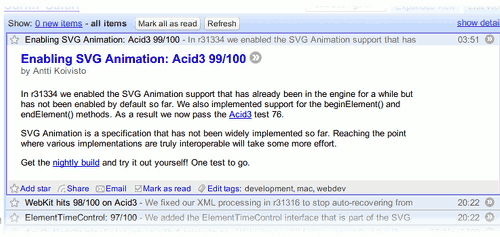
The following image says it all really:

Webkit ACID3 bugfixes

These past few days there’s been a flurry of WebKit posts over at Surfin’ Safari about its ACID3 performance. I guess when dealing with bugs, and given the fact that Microsoft typically needs around 5 years before simple CSS1 bugs are fixed (as an aside the first and only version of Internet Explorer to date that passes ACID2 is 8 Beta 1, released a couple of weeks ago), I was surprised to see how fast the WebKit developers worked towards passing the ACID3 test. Between 20:22 and 03:51 another three ACID3 bugs were fixed, taking the score to 99/100. I guess by tomorrow WebKit will officially be ACID3 compliant. Woohoo!

By comparison, Firefox 3.0 Beta 4 that I’m using to write this post in Ubuntu Hardy Heron Beta1 scores a somewhat respectable 68/100, although I don’t think they’ll pass ACID3 before the final version is out.

comments

»  How Hard could fixing ‘Hardy’ be?

Ubuntu 8.04 is coming on the 24th of April 2008. As is typically the case in the past few years, many millions of Ubuntu users across the globe are either waiting or, in some cases, trying out the pre-release software, reporting and fixing bugs.

Beta 1 of the upcoming version of this popular linux distribution came out a few days ago and, sadly, despite the fact that 8.04 is an LTS (Long Term Support) release, it seems that it’s going to be — by far — one of the buggiest releases ever to come out bearing the name ‘Ubuntu’. In my tests with ‘Beta 1′, there are hundreds of major bugs involving the brand new (and largely unstable) gvfs subsystem for GNOME, application compatibility with PulseAudio and general system behaviour, responsiveness and stability. Having said all that, Ubuntu 8.04, at least in its first Beta is significantly faster than its predecessor.

Having less than a month before the ‘final’ comes out begs the question: is Ubuntu 8.04 going to be delayed so that it matches 7.10 in terms of stability (remember this is supposed to be a Long Term Support release), or is it going to be released on time with a x.xx.1 version coming later in the year? Why has Canonical abandoned the ‘few things at a time, done properly’ approach that it long had with Ubuntu since the beginning? While desktop linux is still sorely lacking the usability foundations that would enable it to compete with OS X, stability was never one of its problems; unless ‘Beta 1′ represented a codebase quite far from what Canonical is working on for release — sadly this is not the case — Ubuntu 8.04 is probably going to be a feature-rich update, but a huge disappointment in the areas where linux traditionally shines.

7 comments

»  The Big Bang Theory

Several months after the writers’ strike interrupted it, TBBT is back and it’s turning out to be one of the funniest satires of contemporary geek culture ever to grace mainstream TV.

1 comments

» A Facebook Survey

I’m sure not too many within the Facebook userbase share my disdain for closed, proprietary networks yet it is not surprising that a significant number of erstwhile facebook fanatics are getting tired of the same old pointless application craze that more or less defined the latter part of 2007 for the network. On the other hand, with OpenSocial having not made any substantial steps towards a concrete presence on the internet and Yahoo’s efforts having completely failed in terms of public adoption and awareness, Facebook remains the one, more or less universal social networking platform and by and large the one with the vast majority of third party applications and meaningful population profiles. I have written about my personal use of the network before: to me it’s merely a universal ‘phonebook’ where I can find old schoolmates, long lost friends from university or other activities and friends of friends that I never got the chance to get to know well enough, but that were somewhat interesting to merit a basic level of communication. I don’t use any of its facilities, not even the basic stuff like messaging (what’s the point? email is much better). It is, in my eyes, merely a directory of people, not a platform for communication. Yet others have used it in considerably different ways: from meeting new people, to ‘wasting’ time using pointless applications, to showcasing their photographs or communicating. The University of Bath has a short survey regarding the use of Facebook. The survey is available in several languages and can be found here. It will probably take less than 5 minutes of your time. Τhe results of this survey are going to be published online after the survey and accompanying analysis are completed.

1 comments


2008.03.09

A week with the OLPC XO-1

The OLPC XO-1 from the side.I’ve been interested in the OLPC project ever since it started in early 2005. For one it represents a great humanitarian effort that — in theory — promises to bridge the gap between the technologically advanced US and Europe and the under-developed or developing countries in Africa, Asia and Latin America. In late 2006 I wrote an article rebutting [article in Hellenic] a — largely ridiculous — claim that the leader of the Panhellenic Socialist Party made at the time whereby he pledged that if his party was elected, they would provide OLPC laptops to everyone from pupils, all the way to university students. I presented a number of arguments as to why such a statement implies ignorance of what the OLPC stands for and what its capabilities are, but more importantly how it diminishes the image of that party (and its leader, a known technophile) with regards to technology whilst at the same time offends anyone who knows a thing or two about technology, usability and the OLPC. What was especially annoying is that the claim took advantage of a good project in order to ‘fool’ those sensitive to educational matters, but ignorant about technology. From anyone even remotely following the project, it is clear that the OLPC is not intended for adults (or even teenagers). It is, after all, one of the ‘core principles’ of the programme and it is also evident throughout the hardware and software design decisions. In that article I also made it clear that I believed that while the OLPC might be an excellent educational and recreational tool that brings computing to the mainstream for millions of children between the ages of 6 and, say, 12 years of age, there should first be a review of the options available to the Hellenic Government when the time comes to procure such a tool and — equally importantly — Hellas, as an EU country, should be very well capable of providing ‘grown-up’ laptops to pupils over the age of 15 and should definitely be able to afford higher end laptops than the OLPC for university students.
»

2 comments

Download Spinalonga's Podsafe rock music for your podcast. From Athens, Greece, with love.'
last.fm