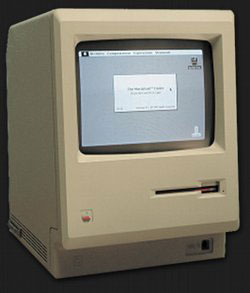
» Happy 25th!
Today is the birthday of the Mac. And while Steve Jobs may not care about the past, a quarter of a century after its introduction, the paradigms made popular by the original Macintosh (and, arguably, the Lisa before it) are still very much relevant in the present and there’s very little proof that they won’t be in the near future.
The original Mac suffered from the same deficiencies so many Macintosh computers suffered over these 25 years since its introduction: low specification hardware (viz. 128KB of RAM), few upgradeability options, a closed ecosystem. Yet it also kickstarted an era of intense innovation and competition, perhaps the golden era of personal computing and marked the beginnings of the Mac’s role in personal computing. While Apple’s focus has drifted away from the Mac as its sole strategic product in recent years, the platform is today as important as healthy as ever. Happy Birthday Macintosh!
Image used under the GFDL licence. Originally by Wikipedia user Grm_Wnr.
Technology and The End Of Capitalism
The recent financial crisis brought back memories of ‘Black Monday’, October 19th, 1987, the day of the greatest financial crisis of the late 20th century and the day the concept and practice of automated trading entered the consciousness of millions of people around the world.
“Imaginary Wealth”. In Search of An Ethical Justification
The ethical value of the capitalist system, of the form in existence in most countries today, is inherently dubious; Some of the typical accusations is that it’s biased towards profit while ignoring arguably much more important aspects of life and society, the human civilisation, personal and social liberty and the environment. That it is unjust and anti-competitive and exploits the weak while protecting the strong and rich — see how debt, prosperity and personal freedom have shifted all over the world, but specifically in the third world in the last forty years. That it is deeply inefficient and promotes corrupt practices. That it presents the illusion of freedom when in reality it is as restrictive as most of the totalitarian systems in the history of mankind, only softer and less aggressive. I’m sure that many will agree with the above criticism while many others won’t. It doesn’t matter.
»
Time for a humorous break. Check this 1980s French Apple Computer Inc. television advertisement. It shows an old wealthy businessman showing his company’s assets to his son (?) in their luxury automobile while explaining that all this will become his, but he should make the decisions alone because his workers should not think, but only execute as they cannot handle making decisions and should just stick to following orders. The ad ends with the narrator saying that “this is one way to run a company, but fortunately there are others”, at which time the apple logo fades in.
And this is why for so long so many people thought Apple was an elitist, out of touch company. For many years its products were mostly appealing (in terms of price and marketing strategy) to people exactly like the old man: elitist and wealthy.
If the ad were from the late 1970s/early 1980s (before Jobs left), it’d probably be a snipe at IBM — the ‘evil’ giant of the time that only had mainframes and micros and dismissed personal computers as toys. Or equally, those that didn’t think personal computers could increase the productivity of their workers. In which case it’d make some sense, but still be be laughably ironic, for Jobs’ own managerial style is probably more authoritative, selfish and hierarchical than any (based on what’s been written about him in numerous books, articles etc.) and would probably make the old man look like an egalitarian-supporting socialist running a cooperative business and making as much as everyone else. But, according to Gruber, the ad came out after Jobs left. It makes little sense: the alternatives to the Mac in the mid to late 1980s, a time of so much competition and so many different architectures and offerings, were more affordable, generally equally productive (at least given the software that was out for a significant part of the tasks people performed at the time) and were definitely accompanied by less arrogant, more pragmatic marketing campaigns, while IBM was clearly far from the all-mighty player in the industry it was half a decade earlier. [via daringfireball.net]
Screwing up the Classics, “Straight to Video”.
It may not be a cinematic masterpiece, or even a particularly good movie, but WarGames (1983) was one of the few Hollywood flicks on the contemporary ‘hacker’ subculture set in a quasi-realistic environment and one that has since become a ‘classic’ of the genre. It’s also one of the few movies by Lasker and Parkes (another being Sneakers from 1992 — notice the similarities?). It’s a shame then, that — as with countless other films — the studios chose to pick up the franchise once again. But even if this might make some sense to some, what certainly doesn’t is following a movie like WarGames with a B-grade, straight-to-DVD release. I guess expecting the studios to get a clue is a bit too much…
It’s fascinating to see how public tolerance of government abuses and downright violation of the law and constitution has increased over the years. Follow the link for the 90 minute PBS documentary from 1987 that deals with how the U.S. sold weapons to Iran, despite its embargo and used the funds to support the ‘contras’ in Nicaragua (the Iran-Contra Affair) before going over the history of U.S. government abuses and illegal clandestine operations in the name of national security post WWII. Now, compare this to the relatively low public reaction to legislation such as the PATRIOT law (and its equivalents in Europe), the reaction to the Iraq war and the minimal buzz in the European press on the matter of the alleged CIA flights transporting illegally detained muslims post the 11th of September of 2001 from Europe to places where they could be interrogated and indeed tortured. No matter what you think of Moyers and PBS, Reagan and US policy in the 1980s and the 2003 Iraq war one thing is clear: people today seem much more apathetic to the abuses by the ‘secret’ governments in both the United States and Europe, even when these affect their own rights, privacy and freedoms, not ‘just’ the fate of some other country or people.

Has Satch lost it?
I first listened to Joe Satriani when I was in high-school, in 1995. At first I found his music pleasantly different from either the hair-metal 80s kitsch (even though some of his early stuff are clearly influenced by the æsthetics of the time) or, the fashionable genre of the time, grunge. Much of Satriani’s music can be characterised as a mixture of guitar virtuoso meets the blues meets the Mixolydian Mode. Some of his early stuff also include some elements of country, 80s music. He’s typically subtler and more structured than most other guitar virtuosos of his time (e.g. Steve Vai), his tracks often conveying a sense of dialogue between two guitars. Some people interpret Satch’s music as a never-ending solo; I tend to disagree: While the guitar undoubtedly has the central stage in his music, his phrasing, melody and structure hardly resembles what you’d define as the archetypal chorus-verse-solo structure of the Rock or Metal genres. Some of his tracks indicate very high levels of musicianship and convey strong emotions, characteristics that go way beyond your typical shredding passage.
»
Diesel and Dust
Σήμερα άκουσα — μετά από πολύ καιρό — το Diesel And Dust. Ίσως επειδή — όπως πάντα συμβαίνει με τη μουσική — έχω τόσες πολλές αναμνήσεις, κυρίως καλές, που καλύπτουν το μεγαλύτερο μέρος της ζωής μου, ίσως επειδή η μουσική είναι εύπεπτη (αν και όχι ξεχωριστή) αλλά παράλληλα τόσο διαχρονική (η σχέση μου με τα 80s είναι κάπως ‘περίεργη’, αλλά η μουσική των Midnight Oil σίγουρα δεν χαρακτηρίζεται ‘τυπική’ των 80s όπως και να το πάρει κανείς). Ίσως επειδή το πολιτικό μήνυμα των Oil είναι τόσο επίκαιρο και σημαντικό είκοσι χρόνια μετά τη κυκλοφορία του δίσκου, το άκουσμα των κομματιών του δίσκου αυτού πάντα με ευχαριστεί. Δυστυχώς ο πιο πολύς κόσμος περιορίζεται στο Beds are burning που έχει καταντήσει, μαζί με πολλά άλλα κομμάτια που αποτέλεσαν ‘Best Of’ κάποιας εποχής, χιλιοπαιγμένο τραγουδάκι που στη πορεία έχασε το όποιο νόημα ήθελαν να περάσουν οι Midnight Oil. Ο δίσκος όμως έχει πολλά περισσότερα να προσφέρει σε όποιον διατίθεται να τον ακούσει!
The Knowledge Navigator
In 1987 Apple was a huge force in the personal computer industry. First of all the industry was ALIVE. Thriving. Evolving. Competing. Apple still had loads of money from the success of the Apple II, the Mac was creating the DTP sector, the now 30-year old desktop paradigm was relatively new and there was no real competition to Mac OS in terms of graphical user interface prowess. This was the time before TalOS/Taligent, before Copland. Before stagnation. This was the time when Apple had the means and the will to do more than sugarcoating existing solid technologies and going after easy money. The Knowledge Navigator was a mock video of Apple’s vision of 2010 personal computers. Some of the ideas found their way in Apple’s ill-fated Newton Personal Digital Assistant — still by far the most impressive PDA ever. Some were realised in the form of the World Wide Web.
»