2011.03.25

My Ten Years With Mac OS X.

Mac OS X 10.0 (Cheetah)Ten years ago, on March 24th, 2001, Mac OS X came out. A first, publicly available, one point oh unpolished version of Apple’s ‘next’ (pun intended) operating system. An operating system that Apple had been trying, in one way or another, to create for more than ten years. Remember Pink? Taligent? Copland? Gershwin? Mythical codenames to those that heard of them in the 1990s of either projects that promised amazing experiences compared to Mac OS Classic and that were never finished or released as planned, or spun-off products that died after a few short years. Mac OS X, what finally became a cornerstone of Apple’s platform well beyond the Mac and a catalyst of its success in the 2000s was a reincarnation of NeXTSTEP in Apple’s colours. Fusing NeXTSTEP’s core and frameworks with the Mac OS of old as one product that didn’t exactly know itself. A new skin, the same — amazingly advanced for their time — underpinnings.

In this short article I will describe, in summary, some experiences with Mac OS X from the point of view of a software engineer as opposed to a user, over the past ten years: The initial chaos of integration, Apple’s flirtation and dilemma with Java, the modernisation of Objective-C, the eventual coherence of the APIs and the extension of the system to support Touch in a way that was never achieved before.

NeXTSTEP frameworks used Objective-C. It was a language unknown to 99% of programmers out there in 2001. I had only heard of it while fiddling with GNUStep a few years earlier. In the early 2000s you could still find C++/Corba programmers in major service companies (as opposed to large software houses or systems development divisions) and Java was only starting, slowly but increasingly, to become the preferred platform for enterprise software. I remember meeting amazing and suitably eccentric software engineers — not merely the subpar ‘developers’ that are increasingly common nowadays in service/enterprise environments — that proudly proclaimed ‘Java is for girls!’ and other elitist, sexist jokes like that. Anything less than Alexandrescu and Sutter-class C++ was unacceptable to them. Knowledge of x86 assembly was standard among their friends. How could a person like that appreciate Objective-C? I felt comfortable hanging out with those people because I had gone through the rings of fire of learning, liking and using assembly, ‘high-level’ [insert CPU here] programming (irony!) and C/C++, but I also enjoyed the elegance and simplicity of Objective-C and Cocoa for rapid application development.
»

2 comments


»  Happy 25th!

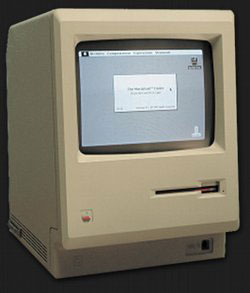
Macintosh 128kToday is the birthday of the Mac. And while Steve Jobs may not care about the past, a quarter of a century after its introduction, the paradigms made popular by the original Macintosh (and, arguably, the Lisa before it) are still very much relevant in the present and there’s very little proof that they won’t be in the near future.

The original Mac suffered from the same deficiencies so many Macintosh computers suffered over these 25 years since its introduction: low specification hardware (viz. 128KB of RAM), few upgradeability options, a closed ecosystem. Yet it also kickstarted an era of intense innovation and competition, perhaps the golden era of personal computing and marked the beginnings of the Mac’s role in personal computing. While Apple’s focus has drifted away from the Mac as its sole strategic product in recent years, the platform is today as important as healthy as ever. Happy Birthday Macintosh!

Image used under the GFDL licence. Originally by Wikipedia user Grm_Wnr.

comments

Download Spinalonga's Podsafe rock music for your podcast. From Athens, Greece, with love.'