Bing and OpenStreetMap
Bing, Microsoft’s portal/search/mapping service has announced that they will start providing OpenStreetMap (OSM) data, as an optional layer, in Bing Maps. OSM data will be downloaded from Microsoft’s fast Azure CDN, as opposed to OSM’s ‘slow’ servers.
Now, there’s nothing wrong with Microsoft using OpenStreetMap data. That’s why it’s Open. But then again, I am surprised how Microsoft can be so obtuse as to not give something back to OpenStreetMap, be it in technical services, financial support or just mapping data — as a token of appreciation for their work. Yahoo did, since 2006, when they allowed OSM to use their (somewhat dated) aerial photography to enrich the database. Many organisations, including Google and Multimap, have in one way or another supported OSM, in parallel with their own commercial mapping activity. Countless smaller organisations and individuals, including us, contribute to OSM whenever possible (I first wrote about OSM here, in late 2007).
On the other hand, Microsoft, one of the world’s largest corporations and — arguably — a leading ambassador of mediocrity — both technically and in terms of marketing — suffices to an announcement that they’ll make use of OSM data in their product, without giving back anything. Clearly because they don’t have to. Also because they, most probably, fail to understand what ‘community’ means. Most certainly because they don’t realise how good any support to OSM, be it technical, financial or just in terms of data, like Yahoo did some years ago, would do to their tarnished public image and their dwindling mindshare among the people that matter, both within the industry and beyond. Quite sad as their support would probably mean a lot to both OSM and Microsoft in its effort to redefine itself in the post-PC era.
Sure, AJAX, when viewed through the prism of the still world of HTML and CSS, can be beautifully dynamic. But, let’s face it, Google Earth — despite its resource-laden design and slow response on slower systems — is a much more natural, a friendlier way to view geographic data. With Microsoft trying hard to reclaim the (tech) lead on mapping (see Virtual Earth, WorldWide Telescope), it’s up to Google to stop the surge.
Enter the Google Earth API and browser plugin — software that opens up Google Earth for use within browsers and accessible by web developers. Sadly, it’s only available for Windows right now — I bet this will change soon.
Nokia has been after the navigation market for quite a while now. The free inclusion of Nokia Maps in some of its high end models and the fact that the application and maps are given for free — with the user optionally purchasing navigation for set amounts of time and having access to updated maps whenever those are available — was in itself a radical departure from the buy-to-own products sold by companies like Tomtom, Navigon, Destinator, Michelin etc.
Nokia’s €5.7bn acquisition of Navteq, one of the two major mapping companies around, cemented what was previously speculation about Nokia’s interest in this market.
While accessible and relatively economical, Nokia Maps 1.0 was not without its problems: a relatively disingenious interface coupled with slow performance left it trailing far behind its leading rivals. Today Nokia released Nokia Maps 2.0 in beta form, for free on their Nokia Betalabs web site. The new application sports a much improved user interface, faster performance, new map modes (satellite and hybrid modes were added) and a clear shift towards catering equally for pedestrians as well as drivers — a very welcome addition, sorely missing for the most part from other offerings.
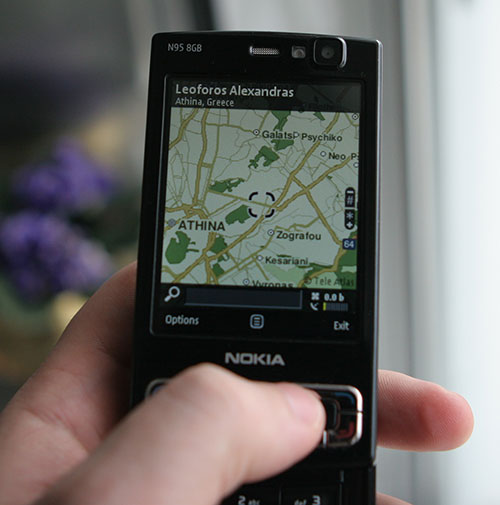
To my eyes, Nokia has already surpassed many of its competitors in the market in navigation and mapping. Its inclusion of free mapping and (paid) navigation functionality in mobile phones leverages its dominant position in the mobile phone industry and might render it a trojan horse, its more ‘traditional’ competitors might not be able to counter. We live, after all, in the era of convergence.

Έχετε GPS και σας αρέσει η χαρτογράφηση; Εαν ναι ίσως αξίζει να ασχοληθείτε με το πρόγραμμα OpenStreetMap, το οποίο είναι μια ανοιχτή, κοινωνική παγκόσμια προσπάθεια χαρτογράφησης του οδικού δικτύου ολόκληρου του πλανήτη. Υποστηρίζεται από το VR Centre, μια κοινή προσπάθεια του UCL και του Ιmperial College London και σε αντίθεση με άλλες εμπορικές προσπάθειες αποτελεί μια δωρεάν, ανοιχτή βάση πληροφοριών. Ιδιαίτερα για μια χώρα όπως η Ελλάδα, όπου οι διαθέσιμες έγκυρες πηγές χαρτογραφικού υλικού στο επίπεδο οδών είναι πενιχρές ή πολύ ακριβές σε σχέση με τον ανεπτυγμένο κόσμο, η ύπαρξη μιας τέτοιας προσπάθειας θα μπορούσε να είναι καταλυτική για την ανάπτυξη λογισμικού και υπηρεσιών που κάνουν χρήση την τοποθεσία του χρήστη. Περισσότερες πληροφορίες και οδηγίες στο wiki της προσπάθειας.


