Tag standards

On CalDAV and Google.

People are annoyed about the demise of Google Reader. Yet more than Google Reader, a service I've used and loved for more than 7 years, I am truly annoyed by the fact that Google is canning CalDAV. And not just because CalDAV is an open, free and widely used protocol (all very good things), but because, in the past, Google has been a champion of open protocols, because its support for CalDAV was reaffirmed only two months ago when it dropped Exchange Support from its Google Docs apps. Because it demonstrates that Google has been somewhat cavalier with its use of 'Openness'.

What about {Angle,Diamond} gradients?

In this draft CSS3 spec, preliminary support for gradients is defined. Where are diamond and angle gradients? They may not be used as much as the others, but I find it weird that they are not added to a newly spec'd standard, given that it's not that hard to implement them.

I dislike Facebook because they’re mediocre.

Facebook has become to the social web what Microsoft is to the desktop: mindbogglingly gargantuan, relentlessly mediocre, and almost inescapable. Like Microsoft twenty years ago, they will succeed because a bad standard is better than none: and like Microsoft ten years ago, they “innovate” by clumsily copying—and then trying to squash—the real innovators.
writes Jon Evans in the linked article on TechCrunch. I find Facebook infinitely more dangerous: Microsoft established itself among a number of proprietary, closed and obscure desktop platforms. Facebook, on the other hand, threatens to engulf and absorb the Web, probably the most open, most amazing development in computing, ever. The path to openness is hard --- we need standards, modelling of semantics and relationships, but above all good implementations making use thereof. Facebook provides an easy, 'closed' alternative, as does twitter and a number of other services building upon their proprietary protocols and interfaces. That's why FOAF and OpenSocial are nowhere to be found and everyone (including us) uses Facebook widgets. Again the age-old saying: "ideas are cheap, implementations cost" rings true, and Facebook have a more popular implementation, like Microsoft did back in its heyday.

Το Στοίχημα της Πληροφορίας.

Σύμφωνα με εκτιμήσεις, μέσα στο 2009 θα ‘παραχθούν’ 4-5 exabytes — δηλαδή τέσσερα με πέντε εκατομμύρια terabytes — νεας, μοναδικής πληροφορίας παγκοσμίως από ιδιώτες και επιχειρήσεις, εξαιρώντας αυτή που παράγεται σε μεγάλα επιστημονικά κέντρα στα πλαίσια ερευνητικών προγραμμάτων (βλ. CERN) ή κυβερνήσεων. Στην εποχή των πολλαπλών διαθέσιμων Terabytes για οικιακή χρήση στην Ευρώπη, τις ΗΠΑ […]

Heavy-handed tactics and Misdeeds

It seems that OOXML, the Microsoft patent-riddled trojan horse and miserable excuse of a standard (let alone an open one) has been approved by ISO, following Norway's and Britain's mysterious (and very suspicious) change of heart. At the same time, 'a number of delegates from the 87 national standards groups have been loudly complaining about alleged heavy-handed tactics and misdeeds in the voting process'. Even if Microsoft products didn't suck, that would be reason enough to actively embargo them.

Today Webkit is on ACID!

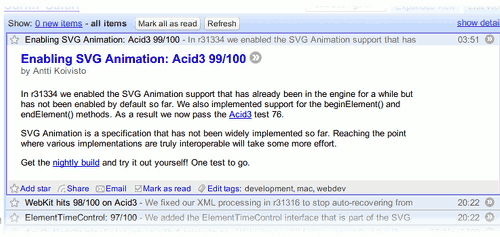
The following image says it all really: Webkit ACID3 bugfixes These past few days there's been a flurry of WebKit posts over at Surfin' Safari about its ACID3 performance. I guess when dealing with bugs, and given the fact that Microsoft typically needs around 5 years before simple CSS1 bugs are fixed (as an aside the first and only version of Internet Explorer to date that passes ACID2 is 8 Beta 1, released a couple of weeks ago), I was surprised to see how fast the WebKit developers worked towards passing the ACID3 test. Between 20:22 and 03:51 another three ACID3 bugs were fixed, taking the score to 99/100. I guess by tomorrow WebKit will officially be ACID3 compliant. Woohoo! By comparison, Firefox 3.0 Beta 4 that I'm using to write this post in Ubuntu Hardy Heron Beta1 scores a somewhat respectable 68/100, although I don't think they'll pass ACID3 before the final version is out.

A plan that will mandate the use of open standards and open source software government-wide

Say the Dutch. And that's excellent news. Government is perhaps the foremost market segment where open source can thrive, evolve and gradually be positioned so as to make inroads in the enterprise. Holland plans to be running open software by mid 2008 at a national (central government) level and 2009 for local and state organisations. Interestingly, according to The Register, the bill was not opposed in parliament, despite Microsoft's protests; on the other hand, I'm sure that many in the Netherlands may be somewhat frustrated by this, although in the longterm I'm sure they'll appreciate the difference. The message is clear: Open Up or be excluded. Who's next?

Android and the Open Handset Alliance.

Apple may have produced a great, polished and closed device in the iPhone. Revolutionary? Nope, but very impressive nevertheless. As a device, as a user interface and — soon — as a platform. Yet in some years from now, what will probably be the iPhone’s single most significant contribution to the world was the belief […]