
Resampling Needed
Those using Firefox 3.0 may have noticed that by default when someone scales the content of a page, the images are resized too, a behaviour long-pioneered by Opera. Those using Firefox 3.0 on linux will be sorry to find out that upscaled images are not resampled using anything but what seems to be nearest neighbour (I haven't checked the code): they are ugly, pixelated and definitely not pleasant to the eye.
This is well documented on the Mozilla Bugzilla repository and sadly it may be the case that it's not fixed until Firefox 3.0 final is out. Which is a shame, as many people with higher resolution displays, especially high-resolution laptop displays that sometimes reach approximately 150dpi actually depend on the scaling functionality to be able to read stuff properly. Ironically GTK+ offers pretty decent image scaling functionality and hopefully it's not that hard to make use of it in Firefox in the near future. Here's an illustration of the problem. The picture on the left shows the original (unscaled) content of the ΜΠΛΟΟΓΚΛ hellenic blog search engine. The one in the middle shows the scaled version, as shown in Firefox 3.0 Beta 5 that shipped with Ubuntu 8.04. The one on the right shows a resampled version of the image using the (pretty computationally expensive) lanczos algorithm, which although not probable as a solution it's quite close to the (realistically possible) bilinear resampling for upscaled images of this size.
 You can follow the progress on this issue on the Mozilla Bug tracking page here.
You can follow the progress on this issue on the Mozilla Bug tracking page here. 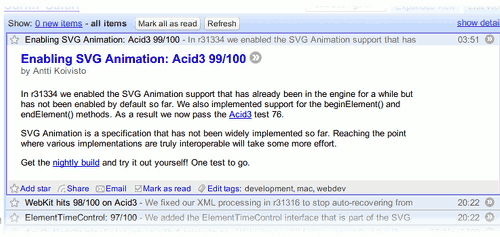 These past few days there's been a flurry of WebKit posts over at Surfin' Safari about its ACID3 performance. I guess when dealing with bugs, and given the fact that Microsoft typically needs around 5 years before simple CSS1 bugs are fixed (as an aside the first and only version of Internet Explorer to date that
  A first attempt at creating a visual UI designer for Android. While not exactly sophisticated compared to more mature visual UI design tools, it greatly simplifies the task for designers (cf. programmers). Worth a look for anyone interested in developing for Android.
  A common joke amongst Mac developers is talking about the Apple HIG, or more specifically the subject of how Apple manages to flout every single principle in user interface design and especially its own in successive revisions of OS X. I've written about this, in one way or another, several times ever since Jaguar came out in August 2002 and the first signs of this disturbing trend became obvious. New UI widgets, new styles and disregard to the HIG continued over the years with Panther, Tiger and now Leopard --- each revision bringing its own flavour of user interface widgets, colour themes and designs, each proving that Apple has no idea what 'consistency' means and that contrary to what they may tell you you should write your own custom widgets or you're probably screwed if you don't (Apple probably writes and uses more undocumented and custom widgets and controls than anyone).
With Aqua so close to becoming part of UI history and Leopard just around the corner, bringing with it yet another completely different UI theme to OS X, it should probably not be surprising when Apple's own Developer Connection web site sports such an inconsistent look. The UI ghosts of yesteryear are still around!
A common joke amongst Mac developers is talking about the Apple HIG, or more specifically the subject of how Apple manages to flout every single principle in user interface design and especially its own in successive revisions of OS X. I've written about this, in one way or another, several times ever since Jaguar came out in August 2002 and the first signs of this disturbing trend became obvious. New UI widgets, new styles and disregard to the HIG continued over the years with Panther, Tiger and now Leopard --- each revision bringing its own flavour of user interface widgets, colour themes and designs, each proving that Apple has no idea what 'consistency' means and that contrary to what they may tell you you should write your own custom widgets or you're probably screwed if you don't (Apple probably writes and uses more undocumented and custom widgets and controls than anyone).
With Aqua so close to becoming part of UI history and Leopard just around the corner, bringing with it yet another completely different UI theme to OS X, it should probably not be surprising when Apple's own Developer Connection web site sports such an inconsistent look. The UI ghosts of yesteryear are still around!