Truckers of Husk - Physical Education EP
It was completely by accident that I stumbled upon this great EP by Welsh/British band Truckers of Husk. I was trying to find a video on YouTube when I accidentally clicked on one of the popular videos titled ‘Sleeveface‘. While the video was mildly amusing, it featured music by Truckers of Husk which led to me looking for the band, visiting their MySpace page and then on to Amazon UK and finally 7digital from where I bought and subsequently downloaded their recent EP, Physical Education EP, for £1.79 (€2.26).
Apparently increasingly popular in Wales and specifically Cardiff, the band plays a structured, yet extremely pleasing style of math rock with several elements of post rock thrown in, with a mellow sound that’s outlined by clean guitar arpeggios, edgy drumming, slap bass and cello, occasionally complemented by stylised vocals. The results are a very pleasant and intense soundscape.
You can listen to much of their work on MySpace, although I guess €2.26 is definitely worth it for the music, especially if you enjoy instrumental math rock in general.
Robot Guitar (’Someone Kill The Marketing People’)
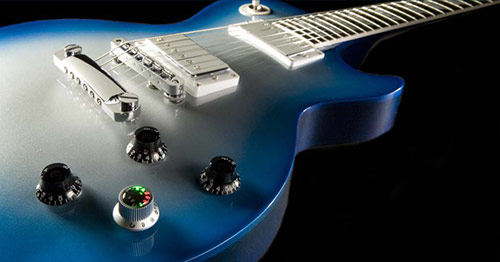
So after the digital pickups now Gibson is releasing an auto-tuning guitar. Great. This does seem like a big deal and I do like it that Gibson is trying to pair modern technology with high quality craftsmanship and vintage design, yet the name, website and associated marketing videos are utterly ridiculous. Do they really think that guitarists are 8 year old retards that would find this kind of promotional material appealing? Ok, they clearly do. Are they? :)

The marketing literature even goes as far as comparing the future value of this limited edition auto-tuning LesPaul to that of a number of legendary guitars including the 1959 Standard; what a sacrilege! The overall presentation goes a long way against maintaining Gibson’s respectable image among musicians.
Still, when the limited run disappears and this becomes a standard feature of Gibsons I’m sure many people will be happier. I know I would if I had one.
Image courtesy of Gibson Guitar Corporation.

Guitar Rig 3
A bit more than a year ago I wrote about Guitar Rig 2, Native Instruments’ flagship product for Guitarists.
Guitar Rig 2 was an excellent product in most ways, with exceptional sound quality, a solid foot controller and several improvements over the original. About two years since Guitar Rig 2 hit the shelves (and the online shops), Native Instruments came out with its successor, Guitar Rig 3. This is the cosmix.org review of the latest in the series of NI’s pro guitar line.
What’s new?
Let’s get over the trivial stuff first: for those using a Mac, Guitar Rig 3 is now a universal binary out of the box and is also Leopard (Mac OS X 10.5) compatible — you can also use it with Tiger of course. For those still stuck on Windows, you can run GR3 on Windows XP SP2 or Windows Vista boxes. It’s price is about the same as its predecessor’s: around €499 for the full version, €299 for the sofware only version and €99 for those upgrading from previous versions (software only). Other options for those interested in upgrading the hardware or upgrading from Guitar Combos also exist. Check the site for more details about pricing in different currencies etc.

Guitar Rig 3 comes with Rig Kontrol 3, the new foot controller that replaces Rig Kontrol 2. It is mostly an evolutionary step forward — as opposed to a completely new design, as was the case with Rig Kontrol 2 versus the original. The new controller provides 8+1 switches (instead of 6+1), a pedal, VU meters for input and output and is black. Most importantly the black aluminum box conceals a brand new new sound interface borrowed from the Audio Kontrol and offering much higher fidelity DAC and a 24bit/192KHz audio interface (it was 24bit/96KHz on Rig Control 2). Rig Kontrol 3 retains the USB2.0 interface — what else would it have? Other than that it doesn’t seem to have changed much with the, now customary, MIDI, input and output connectors on the back.
»
New amps, new effects, new presets and some new features. Woot! If this is anything like the upgrade from version 1 to 2 then we’re in for a rockin’ upgrade. :)
The order has been placed (the ’software edition’ obviously as the new Kontrol is somewhat pointless if you have the previous version). A review is forthcoming, when I get some free time that is…
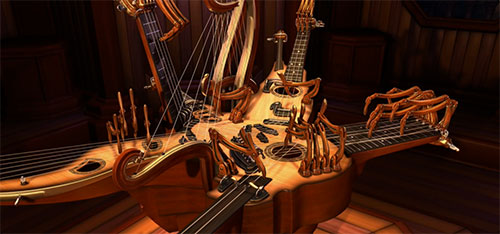
Since Apple announced their support for the H.264 codec back in early 2005 I never bothered revisiting their HD gallery. Until today that is. To many outside the world of computer graphics, Animusic became known from the real-time version of its ‘Pipe Dream’ piece, used for ATi’s Radeon 9700 some years ago. The company has released two collections of tracks on DVD all featuring imagined animated (computer graphics) ‘robotic’ instruments accurately performing the tracks. Needless to say they are quite interesting to watch and very well done. The HD ‘Resonant Chamber’ sample presents a more ‘acoustic’ piece than ‘Pipe Dream’ and one that transcends several musical genres performed by an impossibly complex stringed instrument (a construction that combines guitar, lute, bass and harp) that might invoke images of Pat Metheny’s Pikasso I 42-string guitar. Worth watching.
[Update: Also available on the site is Starship Groove]
String-by-String
Gibson has been more or less synonymous with the electric guitar and along with Fender one of the two major historic manufacturers of the instrument. The introduction of digital technology in what was generally considered acoustic or electric territory was gradual and troublesome. There are lots of people that scoff when faced with computers, modelling based effects units or preamps, software or (even just digital in some cases) effects. It took many years for processing power to reach levels allowing decent emulation of vintage hardware, for software to become sophisticated enough to be accepted by the average rock player or producer, for people to slowly accept digital effects into their audio chain.

Stream the first single from Clutch’s latest album, From Beale Street to Oblivion. Clutch is a band I got to discover just a few weeks ago (thanks to my almost uninterruptible exposure to Spinalongaesque musical selections). Pure. Unadulterated. Almost Cult. :)
[Update: Damn, they've removed the audio file from the site. :(]
[Update 2: Added YouTube video]
Has Satch lost it?
I first listened to Joe Satriani when I was in high-school, in 1995. At first I found his music pleasantly different from either the hair-metal 80s kitsch (even though some of his early stuff are clearly influenced by the æsthetics of the time) or, the fashionable genre of the time, grunge. Much of Satriani’s music can be characterised as a mixture of guitar virtuoso meets the blues meets the Mixolydian Mode. Some of his early stuff also include some elements of country, 80s music. He’s typically subtler and more structured than most other guitar virtuosos of his time (e.g. Steve Vai), his tracks often conveying a sense of dialogue between two guitars. Some people interpret Satch’s music as a never-ending solo; I tend to disagree: While the guitar undoubtedly has the central stage in his music, his phrasing, melody and structure hardly resembles what you’d define as the archetypal chorus-verse-solo structure of the Rock or Metal genres. Some of his tracks indicate very high levels of musicianship and convey strong emotions, characteristics that go way beyond your typical shredding passage.
»