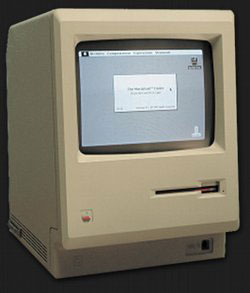
»  Happy 25th!

Macintosh 128kToday is the birthday of the Mac. And while Steve Jobs may not care about the past, a quarter of a century after its introduction, the paradigms made popular by the original Macintosh (and, arguably, the Lisa before it) are still very much relevant in the present and there’s very little proof that they won’t be in the near future.

The original Mac suffered from the same deficiencies so many Macintosh computers suffered over these 25 years since its introduction: low specification hardware (viz. 128KB of RAM), few upgradeability options, a closed ecosystem. Yet it also kickstarted an era of intense innovation and competition, perhaps the golden era of personal computing and marked the beginnings of the Mac’s role in personal computing. While Apple’s focus has drifted away from the Mac as its sole strategic product in recent years, the platform is today as important as healthy as ever. Happy Birthday Macintosh!

Image used under the GFDL licence. Originally by Wikipedia user Grm_Wnr.

comments

» HRDL 1.08 – OTE strikes again!

HRDLΆλλη μια έκδοση του HRDL ώστε να λειτουργει με τις σημερινές σελίδες του ΟΤΕ, και συγκεκριμένα τις αλλαγές που έγιναν πρόσφατα και απέτρεπαν το widget από το να δείχνει σωστά διευθύνσεις.

Περισσότερα στο ChangeLog.

comments

» C4[1] Videos

C4[1] Videos, have been available on Viddler for about a month. For Mac Developers this is probably of some interest. [via daringfireball.net]

comments

» MacHeist ][

For the Macheads among us, MacHeist ][ is here with some pretty impressive applications on offer. For $49, you get apps such as iStopMotion, Awaken, TaskPaper, Cha-ching, 1Password, CoverSutra and AppZapper — with CSSEdit, Snapz Pro X and Pixelmator becoming unlocked after a certain number of bundles are sold. I have been very critical of the previous MacHeist — and I still don’t think it was worth it — but this time the addition of Snapz Pro X and Pixelmator (assuming they are unlocked) make it worthwhile. Given the retail prices and utility of some of these applications, even if you have one or two of the smaller ones, it’s probably worth it.

comments


2006.01.19

Pyxis.

Pyxis

I’ve been meaning to release Pyxis for a long time now. It’s a small GPS application for the Mac, ‘dripping with Aqua beauty’, [other apple-like marketing crap here], fully functioning and quite polished, but there are several things that keep me from releasing it.
»

comments

2003.03.12

Desktops of the future…

It was in 1990 that Microsoft released Windows 3.0, making the PC the dominant platform as it is today, by providing a cheap, easy to use environment for people to use and developers to program (without the horrible Apple royalties that had to be paid for Macintosh development at the time). Windows 3.0, as other graphical desktops before it (Atari, AmigaOS, GEM Desktop etc.) all borrowed from Xerox’ innovation which was commercially introduced to the world with the Macintosh in 1984. But all of those technologies, the concept of a file and a folder represented by a 2D rectangular entity on the screen and the hierarchies that emerge from it are 30 year old ideas that have been proven not to be sufficient for the complex interactions between pieces of information of our times. Computers have grown from (solely) scientific, military, research and statistical instruments to everyday companions in all aspects of modern life: music, cinema, communication, entertainment, task assistance, education; I am sure there are much more.

For those interactions, the leading desktop companies of the early 90s — namely Apple Computer Inc. and Microsoft Corporation — were considering object-oriented desktops with much increased capabilities and a completely departure from the archaic model even ‘advanced’ modern desktop environments (such as those offered by MacOS X and modern Windows as well as all Linux desktops). Projects such as the much-awaited Cairo operating system from Microsoft or the sophisticated Copland successor to MacOS from Apple, gave me, and I am sure millions of others hope for a better future; a time when interacting with your computer, even with the limited CPU power of the mid-90s would be much more sophisticated than the poor experience of Windows or MacOS. Unfortunately, such technologies were never realised in a commercial form. Windows is the most popular desktop operating system in the world, but is still based on 30 year old concepts. Apple Computer, although it provides by far the most well-done integration of UNIX with a graphical, polished environment, offers eye candy and object-orientation which is skin deep. Be Inc., perhaps the only true innovator in terms of desktop innovation of the last decade, is now defunct.
»

comments

Download Spinalonga's Podsafe rock music for your podcast. From Athens, Greece, with love.'