» Bon Iver – Bon Iver (2011)
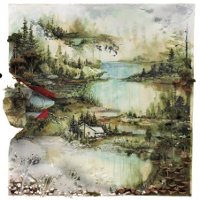
Two days of listening to Bon Iver (the new album) by Justin Vernon’s synonymous band. Part of me admires this guy for evolving, for moving on and not capitalising on what he achieved with ‘For Emma, Forever Ago’ three years ago. Yet another part of me is sad; all that made “For Emma” the jewel it is, is all but gone from this album: the emotion, the pain, the pure, unadulterated sound and simplicity of Vernon’s voice + his acoustic guitar. Without arrangements, without electronics and fx*, without guest musicians or overengineered sonic landscapes. That’s where ‘Bon Iver’ is different to its predecessor and so much like other contemporary indie/folk albums: there may be some glimpses, sporadic moments of brilliance that reminded me why I liked the band in the first place, but as a whole it’s an average album. But then again, it is clear to me that ‘For Emma’ was the exception, not only because of how it was produced (the product of a three month seclusion at a cabin in northwestern Wisconsin), but also because of the ripple it created exactly because it was so authentic yet so different to everything else that made it stand out. In that respect ‘Bon Iver’ is nowhere near ‘For Emma’ territory, but still an album that showcases Vernon’s songwriting ability and unique voice.
* Ok, there is some autotune in use in For Emma..But it really doesn’t detract from the statement above.
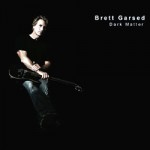
» Brett Garsed – Dark Matter (2011)
It’s nine years since Brett Garsed’s last solo album, Big Sky. And while his output has more or less declined in volume this past decade, his latest album, Dark Matter is a great example of contemporary Rock Fusion, along the lines of Big Sky as well as many of his numerous appearances and collaborations.
Although I only got the album a few hours ago, I have found it to be particularly interesting in that it literally ‘fuses’ (pun intended!) several familiar — at least to me — related styles: Vintage Satch, Liquid Tension Experiment, touches of Holdsworth, Fripp, Metheny and Shawn Lane.
The tracks are more upbeat and energetic than those found in Big Sky; jazzier at times, heavier in others, with a distinct bent on fusion. I particularly enjoyed Avoid the Void, Dark Matter and Enigma, although I cannot say that any of the other tracks were disappointing.
Dark Matter may be an interesting album, yet it is somewhat typical of the genre, which has been largely stagnant for years. It may lack the exceptional feel one finds at times in Big Sky — there are no tracks like Trinity or Drowning, for example — but includes many tracks with more uplifting, polished and — I might argue — technical deliveries of interesting compositions and improvisations that lean heavily on Garsed’s signature technique and sound.
For those enjoying rock fusion, progressive rock and virtuoso guitar instrumentals this is definitely an album worth getting and listening to. Those more familiar with Garsed’s competence and compositional skills (and more demanding of their music) may have expected a bit more.
Inception (2010)
The Thirteenth Floor. Existenz. The Matrix. Movies that more or less, in their respective segments, defined a time, set a trend. That was 1999 and while the first two movies became ‘cult’, mostly due to their lower budgets and respective promotion, the latter ended up being a megahit that drew praise from geeks, critics and philosophers alike, before the writers decided to sell out and botched the story and the universe they created with two poor sequels.
One basic premise of all of those films was the multi-layered existence of the characters, their ability to ‘live’ in mulitple worlds; usually, for the sake of audience comprehension, those worlds were limited to two: the ‘real’ world and a virtual one. A mechanism for moving between these two ‘worlds’ was presented and it always had to do with technology (technology being an easy way to ‘explain’ the impossible without going into much detail). Christopher Nolan could not have escaped the effect that those movies had, when he first imagined Inception in 2001, just a year after Memento, a film he directed and co-wrote, was met with great acclaim. Originally imagined as a horror film, Nolan decided to film Inception as a heist movie instead and this ended up being one of the most important decisions he could have made.
‘Inception’ is a ‘product’ of that first generation of Hollywood productions involving the multi-level existence of the protagonists, but it goes a step further: it marries a complex concept — that of a thief stealing ideas from people while they are dreaming — with masterfully simplified narration, intense action employed as a plot device, as opposed to an entertainment feature of the film, and a superficial, underdeveloped but fundamental to the story backdrop of human emotion. This movie is a brilliantly engineered hollywood blockbuster, rather than a cinematic masterpiece. Great entertainment, it ultimately lacks the originality, the depth, the masterful storytelling that would propel it to levels beyond those of a blockbuster; Action, emotion and scientific/philosophical components are amply sprinkled in support of an average story aimed to satisfy almost everyone watching it.
For those accustomed to brainless Hollywood films, Inception may seem brilliantly nuanced and complex. On the contrary, those trapped within the cinephile, high-brow notions of classic european films, will probably find the marriage of uncelebrated action to a deeper, more complex and, above all, ‘emotional’ setting acceptably thrilling. In the end Inception is a film designed to be liked by the majority of its audience; and that is perhaps its greatest flaw, for it could have been a rare example of great contemporary cinema instead of a polished blockbuster for the masses.
Guitar Rig 4
Two years after Guitar Rig 3 was released in autumn 2007, the fourth iteration of the software modelling application for guitarists was released by Native Instruments. This time around a combination of an ever increasing workload, little free time and the fact that Guitar Rig 3 was ‘good enough’ for my needs meant it took me a while before deciding to buy Guitar Rig 4.
A special offer by Native Instruments landing in my email inbox a few weeks ago, some free time to play the guitar — after weeks of not touching it — and the ease of buying software online meant that Guitar Rig 4 was running on my MacBook Pro in no time.
This release is the first one that dropped support for Power PC Macintosh computers, around three and a half years after Apple stopped selling them. There is no good reason for this change, Guitar Rig 4 would run comfortably on PowerMac G5s and maybe even the last generation of PowerPC-based iMacs.
»
Truckers of Husk – Physical Education EP
It was completely by accident that I stumbled upon this great EP by Welsh/British band Truckers of Husk. I was trying to find a video on YouTube when I accidentally clicked on one of the popular videos titled ‘Sleeveface‘. While the video was mildly amusing, it featured music by Truckers of Husk which led to me looking for the band, visiting their MySpace page and then on to Amazon UK and finally 7digital from where I bought and subsequently downloaded their recent EP, Physical Education EP, for £1.79 (€2.26).
Apparently increasingly popular in Wales and specifically Cardiff, the band plays a structured, yet extremely pleasing style of math rock with several elements of post rock thrown in, with a mellow sound that’s outlined by clean guitar arpeggios, edgy drumming, slap bass and cello, occasionally complemented by stylised vocals. The results are a very pleasant and intense soundscape.
You can listen to much of their work on MySpace, although I guess €2.26 is definitely worth it for the music, especially if you enjoy instrumental math rock in general.
A week with the OLPC XO-1
I’ve been interested in the OLPC project ever since it started in early 2005. For one it represents a great humanitarian effort that — in theory — promises to bridge the gap between the technologically advanced US and Europe and the under-developed or developing countries in Africa, Asia and Latin America. In late 2006 I wrote an article rebutting [article in Hellenic] a — largely ridiculous — claim that the leader of the Panhellenic Socialist Party made at the time whereby he pledged that if his party was elected, they would provide OLPC laptops to everyone from pupils, all the way to university students. I presented a number of arguments as to why such a statement implies ignorance of what the OLPC stands for and what its capabilities are, but more importantly how it diminishes the image of that party (and its leader, a known technophile) with regards to technology whilst at the same time offends anyone who knows a thing or two about technology, usability and the OLPC. What was especially annoying is that the claim took advantage of a good project in order to ‘fool’ those sensitive to educational matters, but ignorant about technology. From anyone even remotely following the project, it is clear that the OLPC is not intended for adults (or even teenagers). It is, after all, one of the ‘core principles’ of the programme and it is also evident throughout the hardware and software design decisions. In that article I also made it clear that I believed that while the OLPC might be an excellent educational and recreational tool that brings computing to the mainstream for millions of children between the ages of 6 and, say, 12 years of age, there should first be a review of the options available to the Hellenic Government when the time comes to procure such a tool and — equally importantly — Hellas, as an EU country, should be very well capable of providing ‘grown-up’ laptops to pupils over the age of 15 and should definitely be able to afford higher end laptops than the OLPC for university students.
»
OMNI: Ghosts
About three months ago and just a few days after posting my review of OMNI’s Paint by Numbers album, I was contacted by the band and asked whether I could write a review of their upcoming Ghosts album. I tried to be as objective as I could in my presentation and criticism, after having listened the album several times since last Saturday, when I received it. This is my review of the new album and probably the first review of the album in general.
In the five years since the release of their first album, OMNI have undergone significant changes as a band. Vocals, once performed by Hans Twite, are now part of Chris and David. Pat Allen, their erstwhile lead guitarist seems to have left the band too, given the band member listing on MySpace (their website was down at the time of writing this review). The feel of the songs has, inevitably, changed too.
If one thing remains is the use of heavy-delay and continuous clean guitar riffs as a pad as well as the experimentation with the Warr guitar in many of the tracks and remains a main differentiating factor of the band’s music along with their varied influences. What has changed is the overall feel of the music, partly due to the considerably different vocals, the more mature composition and lyrics.
A significant variation between the music in Paint By Numbers and Ghosts is the moderate inclusion of progressive metal æsthetics of the type found in music by Dream Theater or Fates Warning in the 1990s. In particular, ‘End Game’, ‘Demon Haunted World’ and ‘Secret to My Success’ reminded me of a number of late 1990s – early 2000s progressive metal tracks.
The vocals in Ghosts are more aggressive and somewhat harsher than those in Paint By Numbers. While good, I found them detached from the feel some of the songs and the æsthetics of the band; for example, while Meridian was perfectly executed and the timbre of the voice matches the feel of the song, this is not the case in ,say, End Game. If anything, I felt that the vocals were a surprise for me and a clear departure from OMNI’s prior work, doing away wit the melancholy of Twite’s voice that shaped much of Omni’s work in the past.
The album has some excellent tracks that once again showcase OMNI’s technical prowess and varied influences. Of considerable musical interest to me were Der Bettler, a very short (1:37) melodic and atmospheric track that opens the album and introduces a musical pattern also found in Fingers Crossed, the final track of the album. Other great tracks were the excellent instrumental Out With a Wimper, Meridian, It Came Crashing Down and The Dead Sky. From listening to Ghosts, it is still evident that OMNI manages to combine a number of influences and still remain original in their sound.
I found parts of Ghosts very appealing in a way that reminded me of the reasons I originally became interested in the band. I must admit, however, that it was not what I expected as a follow-on to Paint By Numbers, five years since the latter came out. In spite of the clear evolution since 2002 and some solid tracks, I found the album often incoherent in style. While the potential is evidently still there — and my appreciation of OMNI’s music remains unabated — I feel that OMNI, perhaps in lieu of the change in the line-up, have yet to fully define their music and æsthetics.
Ghosts came out on the 25th of April 2008.
I would like to thank Chris for sending me Ghosts and asking me to write this review. I’m looking forward to more stuff by the band.
You can find OMNI online at:
The Philips Living Colours LED Lamp
Philips has been an electronics pioneer for many decades and while it has recently been facing stiff competition from newcomers from Asia, there are still some signs of innovation in some of its products.
Light Emitting Diode (LED) lighting is one of the main candidates as a worthy successor of the incandescent bulb as the main source of artificial light. Its currently more popular competitor, fluorescent lighting, as used in traditional tube bulbs and the more recent Compact Fluorecent Lamps (CFL), while energy efficient, is marred by several drawbacks: bad quality light, difficulty in dimming, awkward designs/large footprint.
LED lighting on the other hand provides excellent colour quality, has a very small footprint and is increasingly becoming more powerful, cheaper and much more efficient than before. It has seen extensive use both for decorative and ambient lighting outdoors. Philips has been one of the leading companies providing lighting solutions based on LEDs, after its acquisition of Lumileds, formerly a joint venture with Agilent Technologies (the erstwhile R&D divison of Hewlett Packard). LED lighting is expensive and requires careful design as the LEDs are typically not as powerful as any of the alternatives. They are also comparatively maintenance-free — LEDs have a very, very long life.
While there have been several industrial/commercial projects that employ LEDs in lighting landmarks, bridges, buildings etc. worldwide, as well as extensive use in breaking lights for vehicles or traffic lights among other industrial uses, there has been relatively little penetration of LEDs in home-lighting.
»